

This is an adult gay story if you aren’t an adult or “gay” isn’t your thing, you’d better look for something else to entertain you.🔞 Cheers, Blake
All the previous chapter in the Whitey saga are HERE
If you like what you read, please think about becoming a paying subscriber and support my writing. Thank you!
The story so far (spoilers):
Once upon a time… The idyllic life of Whitey, prince of White Swallow, comes to an abrupt end when King Hardon invades his kingdom, kills his beloved father, and forces his mother to marry him. Years later, the king’s magic mirror reveals to him that there is someone more handsome than himself: the slave prince in the stables. The two men meet, and an irrepressible attraction seems to win over the hatred they feel for each other. The king must find a permanent solution: kill the prince without angering the populace. Whitey befriends Goldween, the king’s cousin and Master Groomer. The friendship is sincere, but the prince is unaware that the king has ordered Goldween to take him for a ride in the countryside and kill him away from the prying eyes of the people. But on the day, instead of killing him Goldween declares his love to the prince. Once their passion consumed Goldween tells Whitey what was the real purpose of their ride and explains to him that he can’t return to White Swallow, sending him instead on a long journey to safety. Whitey walks for three days, seeking shelter wherever he can. Finally, he reaches what appears to be a camp where he is he’s introduced to the men who live there. That evening, around the camp fire, Whitey, listens to an ancient folk tale: the story of Demon and Merlin and truly becomes one of the group... At first, everything goes smoothly. Hardon is convinced that Whitey is dead, and life at the castle resumes its usual routine. Until one day, the King asks the mirror a different question, and the truth is revealed. Goldween manages to escape from White Swallow, but will he be safe or will he unwittingly lead the King to Whitey’s hideout?
Having left the castle behind, shrouded it in the cloud of dust kicked up by Allegro’s gallop, Goldween didn’t quite know where to go next, what to do from there, but of one thing he was certain: he wouldn’t lead the king to Whitey. If Hardon didn’t already know the prince’s whereabouts, his men would soon be on his trail, following him to the camp or, failing that, hunting him down to force him to reveal the truth; and Goldween couldn’t trust himself to be brave enough under torture. His only option was to keep hiding and avoid being discovered at all costs.
But how did the King manage to know the truth? Was there a traitor in the camp? Had the guards discovered Whitey during one of their regular visits? Had they been followed on the day of the ride to Fire Lake ? Yet, if that were the case, why had the King seemed so completely unaware of it, was he bluffing? No, it couldn’t be that; so what had happened?
Moreover, Goldween was worried about his parents: what if Hardon intended to use them to blackmail him and force him to surrender? In the warning message, Master Bate had assured him that he would alert them of the imminent danger—but how? Likely, once again, through the services of his trusted Bullet. Goldween vowed never to shoo away a raven again. And Master Bate! He hadn’t seen that coming: if he was truly part of the resistance, it meant the movement against the Emperor and his allies was still alive and still had cards to play.
He had left the castle and White Swallow taking nothing with him but the clothes he was wearing and his horse. Fortunately, it was high summer, and the orchards and fields were teeming with produce, but he needed to find support if he wanted to escape the manhunt unleashed by the king.
As he rode toward the mountains to the east, a plan began to take shape: it was vague and full of ifs, yet a plan nonetheless.
He decided to cross the mountains and head north, keeping well away from the main route and following the old passes instead. These were the paths traveled by the ancients—before the kingdoms and the Empire, before the new faith. Now these routes wound through abandoned villages and remote hamlets where he knew members of the resistance were hiding. They would help him, of that he was certain.
The problem was that, to reach the north, he would have to cross kingdoms whose rulers were loyal to the Emperor; not only that: the Imperial guards had the right to hunt him down wherever they pleased. And yet, that was still his safest option.
If he kept a good pace, he could reach the Northern Kingdom in seven nights. There he’d be safer.
Goldween spent the first night at the foot of the Eastern Mountain; he found shelter deep in the forest, where the roots of a fallen tree rose up like a wall. In its fall, the tree had left a hollow into which he crawled. He tethered Allegro nearby, lit a fire with some tinder to keep the beasts at bay, and began to eat some of the fruit he had stolen from an orchard.
Sleep came sooner than expected, but not the kind that carries rest.
Dreams overlapped, dissolving into one other in a senseless fog.
And Whitey was in all of them..
They were in a room; a sumptuous banquet was laid out on a marble table. The setting was opulent, with rich gold and red velvets, yet everything around them was black: the room was floating in the void.
“It looks delicious,” Whitey said, approaching the table, his hand poised to snatch an exotic fruit. He was the same Whitey Goldween had seen in the stables: the slave dressed in a sack, with dirt under his fingernails and an unkempt beard. And yet, so incredibly handsome.
“Don’t! It’s a trap!” he shouted, but no sound escaped his lips, and Whitey’s hand grasped the fruit.
It was then that the figure of the king emerged from the deepest void. He ignored Goldween, keeping his eyes fixed on the slave-prince.
“Go ahead, help yourself,” the king said in his deepest voice, though Goldween could sense a note of hesitation in it. Fear?
Whitey turned, smiled at the king, raised the fruit to his lips, and took a bite. Only now he was naked, his body washed and his beard neatly groomed. The king stepped closer, reached for Whitey’s member, and they kissed, while his fist slid along the prince’s mast. Goldween stood frozen, unable to move, cry, or look away. Then, suddenly, they were no longer in that room, but in a field; he and Whitey, they hastily undressed and, naked, began rolling in the tall grass—playful, yet aware of what was to come. Their hardness pressed against their skin as they tumbled, muscles glistening with sweat beneath the high sun. Then, something in the distance caught his eye. The castle! It was on fire; plumes of black smoke rose into the blue sky, enveloping the entire town. People were screaming and fleeing toward the fields—toward them. The shouts grew ever louder.
Then he woke, but the shouts persisted: “He went this way!”, “Look, there’s a light over there!” Dogs were barking.
He could not wait another moment; he crawled from his hiding place, mounted Allegro, and spurred him into the darkness of the moonless night. Branches lashed at him, hard; he pressed himself flat against the horse’s body, feeling pity for the poor beast. At first, the barking of the dogs was right at his heels, but soon began to fade into the distance muffled by the green curtain of the forest. Had he waited a moment longer, they would have caught him.
But how? How could the King already know his whereabouts? He had been cautious, wading through rivers to wash away his scent and that of his horse. He had not been followed—of that he was certain—and had steered clear of towns, villages, and farms; even when he stole fruit from an orchard, he was miles away from the nearest hamlet. He could have understood if the guards had intercepted him later in his flight, but not this soon, before he had even had a chance to make a mistake.
He had to change his plan: he did not yet know how many soldiers were on his trail, but he sensed they had realized his intention to head for the pass; they would follow him there, or perhaps they were already lying in wait for him. So, he headed west instead, through the wooded plain, crossing the main river again and again to throw his pursuers off the scent. Little he knew that it was all in vain.
Back at the castle, Hardon was losing patience: six days had passed since Goldween’s escape, and his men had still failed to capture him. They had spotted him, chased him, and set dogs on his trail, yet that traitorous cousin of his had always managed to slip away.
The King spent more and more time alone in his chambers, drinking. What a fool he had been to trust Goldween! Of course, that pathetic wretch had seized the chance for revenge, still whining about that arrow accident from so many years before: “Oh look at me, poor me, poor one-eyed Goldie... no one loves me...” the king would repeat with a fastidious intonation to an imaginary audience. It wasn’t his fault his cousin was second in line to the throne; he would have done anything to prune that useless branch of the family from the succession. Unfortunately, however, he hadn’t died. Luckily, Hardon had sired enough bastards to choose one from the litter, acknowledge him, and name him his heir. But Goldween’s affront had been too serious. This time, Hardon didn’t care if his actions were too blatant—it would be the end for his cousin.
Then there was the matter of Master Bate: who would have imagined his loyal, long-serving chamberlain was plotting behind his back? He was almost impressed by it.
When the guards and Master Bate went looking for Goldween and found him riding away from the castle, it was clear he had been tipped off; and there was only one person who could have done it: Master Bate himself. He had sent the guards to alert the king of Goldween’s escape so he could use those few minutes to flee as well—mounting a horse and riding off with that cursed raven flying overhead. The king was furious, but Master Bate could wait; They would find him; he was certain of it. Goldween was his priority.
And so the King burned with indignation, for no one had ever dared to treat him like that before.
In his marbled chamber, he had drawn the heavy curtains to shut out the sun and, alone and drunk, would spend his days questioning his magic mirror.
It was his trusted weapon—the only being, if it could be called such, that knew all his secrets.
Yet this didn’t do much to soothe his frustration, for the mirror could only speak and and be spoken to in rhyme—a pointless game which managed only to further irritate the drunken king.
Truth to be told, that wasn’t entirely accurate: the mirror was merely a victim here—a gift to the King, compelled to speak the truth, and nothing but the truth.
Thus, figuring out it had fallen into the hands—or rather, was hanging on the wall—of a cruel man, the good mirror hit upon the idea of rhyming. It thought it might be a way to slow down his master’s perverse machinations. It was not a lie, merely a ruse, and the King never questioned it, convinced that if the mirror had said it was so, it had to be so.
By the power of magic, Hardon could ask the mirror only ten questions between dawn and midnight, and was granted a single vision each day
He had to be wise in how he used his chances—especially now that he was on the hunt.
And so began the silly game..
A back-and-forth exchange, featuring several variations of : “Magic mirror us between, tell me where to find Goldween.” The mirror would invariably reply with something like: “My dear king, as for Goldween, you shall find him in the green”—which, technically, was not a lie.
The king was thus forced to come up with new rhymes and fine tune his questions, until the mirror provided some useful clues.
That is why, on the first night, the guards took so long to reach the fugitive’s shelter, and why they always seemed to arrive just a moment too late: it had become a game of cat and mouse, in which the mouse always managed to slip from the cat’s clutches.
And then there were the visions...
Of course, King Hardon intended to get rid of Whitey, but that could also wait: the prince couldn’t know that his hiding place had been discovered (it had been easy: a few well-aimed questions were all it took for the Mirror to answer Wolftooth mountain), nor that the king knew he was still alive. He might as well let him enjoy his final days. There was nothing more gratifying than holding someone’s life in one’s hands—especially when that someone had not the slightest suspicion of what was coming for them. Hardon had always loved visiting the slaughterhouse, particularly when the animals gathered in the outer pasture, cheerfully following the men who had fed them until that day. He enjoyed the look in the beast’s eyes when they finally realized the end had come.
But there was more: the visions! They allowed Hardon to spy on his favorite subject—a source of unparalleled pleasure and blinding jealousy.
The first time, it happened by chance: it was late afternoon, and he had simply asked the mirror to show him Whitey, to see the place where he was hiding, a chance to look at the face he so desperately craved and impossibly hated.
Imagine, then, his surprise when the mirror revealed the prince naked, his body glistening with drops of water as he emerged from a wide, slow-moving river. The king held his breath; his heart began to pound, and a rush of blood instantly surged to his groin. The image wasn’t sharp, yet it was clear enough to transport Hardon back in time—to their encounters, to the last moment he had seen him in that very same chamber.
Whitey was smiling, speaking to someone before him, just out of the mirror’s frame. He had taken his manhood in hand and begun to caress it; there were other naked men in the distance, in the water behind him, but the prince seemed not to care. He reached the shade of some trees, where another man lay naked in a hammock; this man was muscular—more so than Whitey—his torso a solid mass covered in a thick fur of blond hair.
The man said something, though no sound came from the mirror; he laughed as he stroked his own large, hardness. Whitey stepped closer, his member erect—how well Hardon remembered it! The other man simply leaned forward, opened his mouth, and swallowed the head of Whitey’s mast.
Hardon hadn’t even realized it, but his tunic now lay at his feet; he was gripping his own flesh, tears streaming down his cheeks.
He did not know how long he had stood there. Though his eyes were open, he had not seen Whitey cum, yet the man’s beard was now coated in a whitish mess. Whitey was kissing him while his hand slid along the other man’s shaft until he also came; Whitey straightened up, only to bend down again licking the cum from the stranger’s body.
The king himself gave his hard flesh one last stroke, releasing a jet of semen that fell onto the marble floor, away from the tunic pooled around his feet—a garment that now reminded him of an emptied-out corpse. He fell to his knees, weeping. That release brought him no relief—on the contrary, he felt emptier than before. That pathetic spurt of semen—the first of many, though he did not yet know it—served only to remind him of his own weakness, almost as if to mock him. It was proof that a moment of ecstasy merely bore witness to a lifetime filled with regret and shame. He remained still dangerously at Whitey’s mercy, unable to resist him.
Goldween had been on the run for twelve days. Whenever he thought he was safe, something would happen to force him back into the saddle in a hurry: dogs barking in the distance, noisy flocks of birds unveiling the arrival of his pursuers, or small clouds of dust, lifted by running horses, spotted from high vantage points. No matter what he did or which direction he took, they always seemed to be hot on his heels. He had spent most of that time alone; whenever he met people he recognized as members of the resistance, he made sure not to linger—staying just long enough to secure some food and exchange information before moving on, fearing his presence might endanger his hosts.
Finally, on the morning of the thirteenth day, he reached the border of the Northern Kingdom, having once again eluded a pack of dogs unleashed to track him down. He had spent the night in a small cave; the weather had turned, and cold rain mixed with hail was battering the forest. He had fallen asleep after a long, restless night—his body finally succumbing to the exhaustion of laying on the ground for days—and the sound of the rain had masked the pack’s approach. A tremendous crack of thunder woke him; it was still dark, and only then, illuminated by the next flash of lightning, did he see the silhouettes of the dogs running toward him. Another peal of thunder followed, the dogs, startled and disoriented, stopped in their tracks, giving once again Goldween time to leap onto Allegro and gallop away through the driving rain.
He was too close to his goal to change his plans again: he had to reach the Northern Kingdom at all costs.
During the previous days his arduous journey had driven him further west than he had anticipated; he then headed north, keeping to the western slopes of the mountains. There, the passes lay higher up the mountainside; they were narrower and harder to traverse, especially in such weather. What lay ahead of him was no longer a path, but merely an animal track—one that became increasingly indistinguishable from the rocky terrain the higher up he went.
He had prepared for a situation like this his entire life—ever since Hardon had struck him with the arrow... the accident. He knew that one day he would have to flee from his cousin, and that the only way to succeed was to know the lie of the land. He had studied maps and ancient records, and had undertaken long rides himself. Yet, he had never ventured this far from his native kingdom.
Now he was high in the mountains—so high that, even in the middle of summer, the rain fell as snow, making the path even harder to follow. He could only hope that the falling snow would make it more difficult for his pursuers to track him down.
He knew he had to climb higher still; Allegro—poor Allegro—was exhausted. Goldween had promised his horse that, once safe in the Northern Kingdom, he would be able to rest for a week in the greenest pastures.
Greenest pastures, eh? Did such things really exist in this foreign realm?
The Northern Kingdom: a land of narrow valleys carved into the mountain rock, where summers are short and the winter darkness lasts for months. Those valleys were inhabited by a proud folk—the Ancients—who had lived on the land before Goldween’s people arrived centuries earlier, driving them away into the inhospitable North. Over time, they had to compromise and accept that, to survive, they needed to integrate with the newcomers and eventually being assimilated into the Empire; yet the “Northern”—as they were simply called—had never fully done so. They continued to speak their own language among themselves worshipping forest spirits and fairies and converting to the new religion in name only. The North: a land of magic and rituals as ancient as the rock from which it was made.
Goldween was almost there, a gray light was breaking the night, but he was cold; his clothes were soaked, and he could not stop shivering. If only he could close his eyes, even for a moment—close his eyes and forget everything.
- El g’ha dervì l’œgg!- Dirma was crouching beside the stranger; for a moment, she had feared they had lost him—his body stiff and motionless, his breathing far too slow. But in the last few minutes, he had shown clear signs of life: fingers drumming, lips twitching. And now, he had opened his eye and was looking at her.
-L’œgg?- What a funny thing to say— eye! What about the other one? Sometimes Elsar wondered if Dirma was losing it a bit; she hadn’t even reached her 80th summer yet— a bit early for something like that.
- Sì, g’ha sultant vun- Here we go again: Elsar had already forgotten that the stranger had only one eye. There was only a five-year age gap between them, yet there were worrying signs.
- Pota, me son desmentegàda- Elsar turned back to tend the fire, surprised: how could she have forgotten that?
They lived in an remote house at the head of the valley; it was the first dwelling one encountered when entering the Northern Kingdom via the nearest pass.
House. Calling it that was perhaps an overstatement: it was a simple rectangular structure of stone and timber. It had a flat wooden ceiling topped by a hayloft where they stored fodder for the winter—an ideal arrangement for both the animals and for keeping the heat in. Above that, a steep roof prevented the winter snow from piling up and causing the whole structure to collapse.
Next to it stood the stable, housing a few cows, some hens, and a cock.
“The only cock for miles” they always joked.
And now there was one right inside their house. And a large one, too.
They had had to undress the stranger; his clothes were wetter than if he had fallen into a river. Perhaps he had fallen into one—was that something else Elsar had forgotten?
She and Dirma were having breakfast earlier that morning, watching the grey light push through the curtains of rain. There wouldn’t be much to do: no plot to tend, no trip down to the village. They would stay indoors, mending clothes and playing cards.
Elsar, seated at the table, was looking out the window when a large horse’s head blocked her view.
Startled, at first, she thought of a Dahu, but the animal was too big, and those creatures preferred to keep to themselves rather than go snooping around people’s houses. Then she realized it was just a horse. How queer!
Dirma had fallen back asleep—she had never been a morning person—so Elsar woke her up up, they took the club they kept aside for occasions like such, and stepped out into the driving rain.
The horse stood motionless, looking miserable—though not as miserable as the body it carried. A fair-haired man—young, judging by his appearance—lay across its back, his rigid arms wrapped around the animal’s neck.
Was he dead? Dirma held a finger under his nose and, after a moment, confirmed he was still breathing; only just. The horse, a stallion had seemed to understand what was expected of him and knelt on his forelegs to help the two elderly women get his master down.
It was an arduous task; eventually, they decided to bring out a large blanket, roll the man onto it, and slowly drag him inside, where they proceeded to undress him, so revealing his strong body and impressive manhood. Not that either woman had ever taken any interest in such things.
Now that he was awake, he felt the weight of several blankets pressing down on his body.
He reached up to where his eye patch should have been, but instead touched the soft, hollowed-out skin, which he instinctively covered with his hand.
The elderly woman crouched beside him said something in a language he didn’t understand. Noticing his confusion, she repeated the words with a heavy Bervian accent.
“It was too wet, so we had to take it off—but don’t worry, it’s right there; it should be dry by now.” She pointed to his eye patch, which lay limp on the back of a chair near the fire.
“Thank you...” He looked at her, then at the other woman—even older—standing behind her.
“You’re welcome. I’m Dirma, and that’s Elsar, my wife.”
“Hello, stranger.” Elsar gave a wave.
Wife? Goldween had heard of women who preferred to lie with other women, but he had never actually met any. At court, they were spoken of almost like mythical figures— man fancies, yes, there were plenty of those (he was one himself), but the idea that a woman might not be interested in a man’s body was considered either a joke or some sort of foreign ailment.
“You look troubled; do people like us not exist where you come from?”
“I... I’m sorry, it’s not that. Actually, I don’t know—I’ve just never come across women like you. Forgive me if I seemed rude. I’m Goldween, and I think I owe my life to you.”
“Yes, to us—and to your horse! He gave me quite a scare this morning.”
Allegro! Goldween had forgotten all about him. Seeing the concern on his face, Dirma reassured him: “He’s safe—in the stable with the cows; we’ve fed him.”
“I am infinitely grateful to you, and do not worry—your help will not be forgotten. But I cannot stay here; I would put you in danger!”
The two women looked at him in bewilderment: who was this stranger? Why would his presence pose a risk to them?
They had prepared some porridge and helped Goldween to stand up. As he did so, he realized he was stark naked; embarrassed, he covered his private parts with his hands.
“Don’t worry. Not interested and never have been” Elsar reassured him as she stirred a little cinnamon into the bowl. “Your clothes are dry; you can put them back on.”
He did so, but—as always—the first thing he went for was his eye patch. Then, he went to sit at the small table.
He hadn’t realized just how hungry he was. As he lifted the food to his mouth and helped himself to a second portion, he told the two elderly women how and why he had ended up there. They listened intently; hearing him speak of Whitey—and seeing how his face lit up at the mere mention of that name—they understood everything, though they said nothing. When he finished, silence fell: the rain had stopped, and the afternoon sunrays were piercing the clouds like divine fingers.
“You still have time, but not much,” Dirma said confidently.
“What do you mean? The king’s guards are hunting me relentlessly; they could be here at any moment! They might kill you if they thought you’d helped me...”
“Here in the Northern Kingdom, things work differently; other forces come into play. It is harder for your king to interfere. But he will, of course; given a little more time, he will.”
The two women exchanged a glance; Goldween wasn’t entirely convinced by what they were saying. Were they wise or simply a little senile?
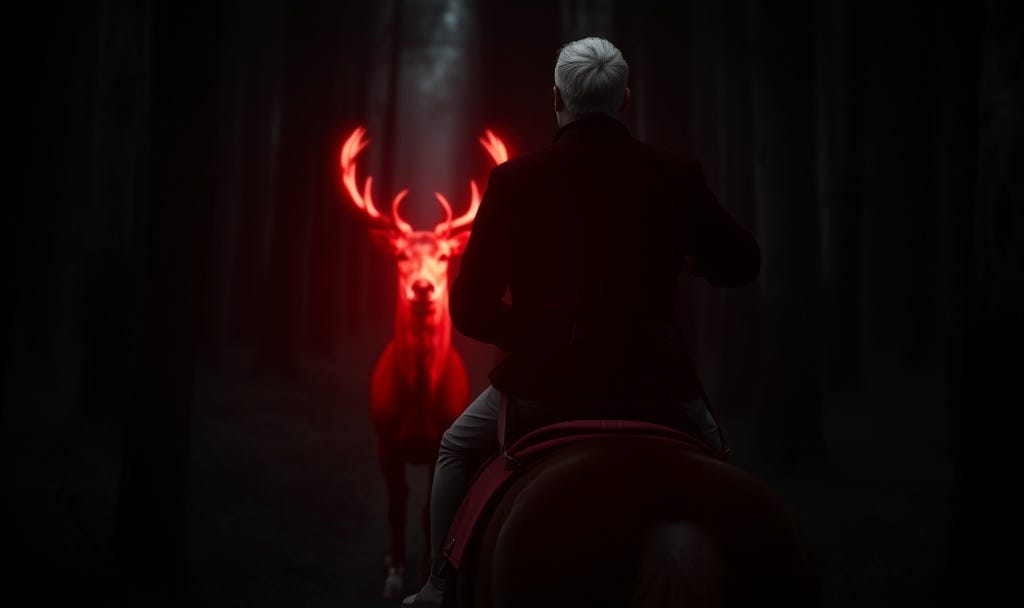
“Listen: eat some more, then, when you are ready do exactly as we say. There is a path that starts at Raven Rock. Head east, and you can’t go wrong. Follow it until you reach Black Pond and wait there—I do not know for how long. A red stag will come to visit you. Follow it until you reach your destination. Do you understand?”
Goldween nodded; he understood, certainly, but that didn’t mean it made any sense to him.
Once he had finished eating, Goldween announced it was time to continue on his journey. The two women protested, telling him there was no rush—that he should spend the night with them and ensure he was strong enough before setting out again. But he would hear none of it: his presence was dangerous, and the last thing he wanted was to put those who had saved him at risk.
Outside the stone house, Elsar brought Allegro to him. The horse let out a joyful whinny and rubbed his soft muzzle against his master.
“Thank you, my friend; without you, I would be dead,” he whispered into the animal’s ear, then turned his gaze toward the two elderly women. They looked so frail.
“It is a great shame that women like you must live apart from other folk—because of who you are, because of whom you love...”
Elsar and Dirma exchanged a glance and burst out laughing.
“My dear friend” Dirma said apologetically, “the fact that we live up here has nothing to do with who we are. When we got married, many, many years ago, the whole village came to celebrate! You see, things work differently in the Northern Kingdom: we believe that to sin is to deliberately hurt someone, not to love them—whoever they may be.”
It was wonderful; Goldween couldn’t help but wish that was the case everywhere.
“Why do you live up here then, all alone, miles away from the nearest dwelling?”
It was Elsar who spoke: “But we aren’t alone! The villagers come often to bring us clothes to mend and whatever we need, in exchange for our work! Look around you. Isn’t it wonderful? Have you ever seen a more beautiful view?” Goldween did so and understood: now that the rain had stopped and the low clouds had cleared, he found himself admiring steep pastures climbing the mountainside, and trees and forests that seemed to spring directly from the rock; down in the valley, the first lights were piercing the dark from the houses of a small village—already in the shadow of the peaks he had just crossed, peaks capped with snow and tinged pink by the evening sun. It was a breathtaking sight. “You’re right, it’s majestic. But please, be careful!”
“We will, don’t worry. And you too. You know something? That Whitey is lucky to have you in his life.” they winked.
Elsar stepped forward to hug him, and Dirma did the same. Goldween mounted Allegro; after glancing back one last time he waved his hand and rode eastward toward Raven Rock.
Goldween’s journal
The path I had taken, instead of descending into the valley, wound along the mountainside, arching eastward toward the encroaching night. To my left lay a steep, rocky slope where only a few trees dared to take root; to my right opened a dizzying chasm, hundreds of meters deep. The scenery was magnificent, yet the slightest error from Allegro could have cost us our lives. We proceeded like this for about an hour, Advancing slowly, until we came upon a rock formation whose shape unmistakably revealed its name: a granite raven stood before me, as if a sculptor had sought to immortalize a bird poised for flight. Its beak pointed north, toward the spot where a second path branched off from the one I was following, leading into a secluded valley.
It was like entering a secret world: once past the narrow passage, the valley opened onto a small, wooded plain—a natural amphitheater carved into the rock. I had read descriptions of craters, and I felt as though I were standing right inside one. The darkness was deeper still in there, compounded by the dense vegetation, but at least the path was safer, cutting straight across the center of the circular plain.
In that darkness, how could I know if I came across the right pond? We rode past one, but nothing suggested it was the one I was looking for: Black Pond. I dismounted from Allegro anyway, cupped some water in my hand, and—even in the dark—saw that it was chrystal clear; I knew that was not the place where I was meant to wait for the red stag. We kept on going on until we entered a bank of fog—just what we needed! Ravens or similar birds cawed, hidden in the mist; an owl hooted, and shadows seemed to move among the trees. I could sense Allegro’s nervousness, and I imagine he could sense mine.
We pressed on, alert, until suddenly the fog lifted and we found ourselves on the banks of a large, circular pond. Everything was still—no birds, no shadows; the wall of fog now encircled us and the pond like a pearly curtain. Once again I dismounted from Allegro, and this time, as I scooped up the water, my hand was coated in a black, oily liquid.
We were in the right place. Allegro had calmed down and was grazing on the lush grass growing along the bank. I found a large stone, sat on it, and waited.
When Dirma and Elsar had told me about the red stag—bizarre as it might have seemed—I expected an animal with a coat the color of autumn leaves. In any case, I doubted I would be able to make out its color in the darkness. I guessed I would simply follow the first stag that showed an interest in me.
Imagine my surprise, then, when an hour or so later I saw a light making its way through the curtain of fog; at first, I thought another traveler had followed the same path I had taken. That could have been bad news and I tightened my grip on the club the two old ladies had gifted me. But as the light drew closer, I realized I was about to meet my date.
The large stag radiated a light of its own, red as a flame, from within; I had never seen—nor have I seen since—a more beautiful beasts. It advanced slowly toward me, circling the rock where I sat. Allegro seemed intrigued by the newcomer but not at all frightened; in fact, he moved toward the stag as if to greet it. I felt as though the stag were studying me, weighing my worth. Then it stopped, moved away and turned to check what I was doing, it moved a little further away, and did the same again. I understood that it expected me to follow.
I swung back onto Allegro, and together we set off, behind the flaming stag.
I don’t know how long we had been following that creature, but it didn’t seem much. Because of its light, everything around us appeared even gloomier; in some ways, it reminded me of the scene from my dream—only this time, I wasn’t in the king’s chamber, but in the middle of a forest—and not just any forest, I thought.
The stag had slowed down; in the distance, ahead of us, I glimpsed another faint source of light—for all I knew, it could have been a star. However, the closer we got, the more I realized that the light was coming from a higher point up the mountain slope. We had reached the edge of the plain, and now the path began to climb steeply among the rocks.
Eventually, we arrived at what looked like the mouth of a cave; that was where the light was coming from. The stag stopped, and then—as if its uniqueness weren’t enough—the animal let out an extraordinary sound: deep and low, yet incredibly uplifting. We all waited, until I saw a figure emerge from the cave.
At first, I thought I was dreaming: how was it possible? There, before me, was Whitey—naked, just as I had last seen him on the shores of Fire Lake. I had to restrain myself from leaping off Allegro, run toward him and throw myself into his arms.
But then he spoke.
“Who have you brought us?” he asked, addressing the stag; it wasn’t Whitey. My eyes had adjusted to the light by then, and the stranger was closer to us. He looked at me, then turned back to the stag: “You’ve done a fine job; Demon will be pleased.”
Then he turned toward me again, finally acknowledging my presence: “Hello, I am Merlin. Please, come in; you look tired,” he said, gesturing for me to follow him. “Don’t worry about your horse; he’ll be in excellent company with our Blaze,” he added, as if reading my mind.
I dismounted from Allegro and followed Merlin into the cave, unsure of what to expect.
Seeing him naked—his muscular, rounded buttocks swaying before my eyes—awakened an instinct I had suppressed ever since I began my flight. It was like not realizing how hungry you are until food is offered to you.
